

Passing Down Love: How Family Traditions Keep Asian Americans Connected

Family traditions — from shared meals to quiet gestures — help Asian Americans stay rooted in love, identity, and connection across generations.
This article is part of Mochi’s spring 2025 issue on Traditions, where we examine how cultural practices shape, challenge, and evolve within our lives today.
Even as a mother of three kids in my late 40s, I still feel like my wisdom, life experience, and parental expertise are meaningless when I am with my parents. Unable to be anything but parents, they dole out unproven yet enduring beliefs: in the form of superstitions, “If you go to bed with wet hair, you’ll get a headache!”; parental admonishments, “Ai-yah, it’s so cold out — bring a jacket!”; and unconventional medical advice, “You have a canker sore? You must’ve eaten too many 熱氣 foods,” implying that an abundance of hot foods created imbalance in my body.
But despite the loudly shared advice, my parents have also passed down some traditions and practices that are a part of who I am today — ones that give me a sense of connection to them and extended family, even if they aren’t explicitly connected with our Chinese heritage. Some of these are clearly articulated, and some were simply modeled in my childhood.
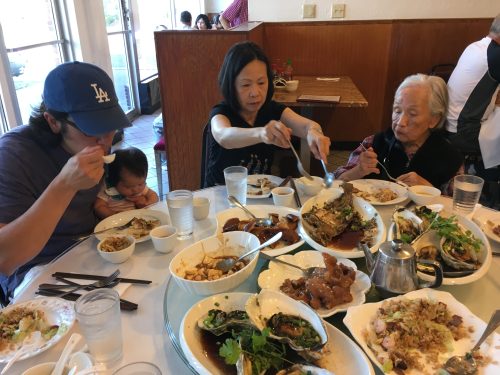
For example, whenever we arrived at a family gathering, we were expected to greet everyone before settling in. Also, during family-style meals, we knew not to take the last piece of a dish unless we asked first if anyone else wanted it (and secretly hoped no one would say yes).
For many years, our family used Chinese kinship terms when referring to ourselves and extended family members. As my sister and I grew older and English became the primary language in our household, those kinship terms faded, now only present in conversations with my maternal grandma, my sole remaining grandparent.
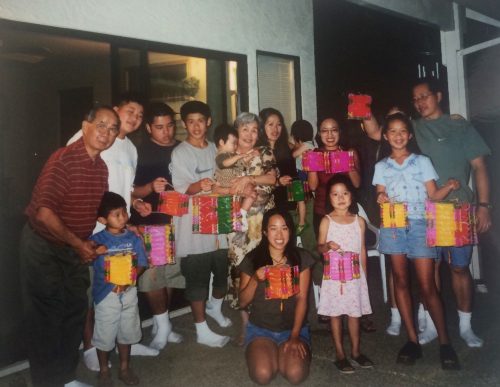
My parents had a longstanding tradition of treating my grandparents to a meal on their own birthdays, to thank them for their parental love and care. This tradition was passed down when my sister and I were children, even if it meant only being able to afford a meal at McDonald’s. This year, my parents gave my youngest daughter money for her birthday and instructions to treat my husband and me to a meal. For her birthday, we went out for aḉai bowls.
When I became a parent, I placed shame and disappointment on myself for not having more cultural traditions to teach my kids. We didn’t practice rituals around births and deaths, like Vietnamese death rites and ancestral worship, or jesa, a Korean death ritual. My parents occasionally took us to my great-grandma’s grave, but we didn’t recognize the occasion as the Qingming Festival, or Tomb Sweeping Day. Chinese New Year received less fanfare than Christmas or Thanksgiving.
Due to the fact that my family more strongly identified with a Christian identity, and because my parents immigrated to the U.S. at an early age, cultural traditions weren’t prioritized within our family, especially if they remotely contradicted Christian beliefs.
As an adult, I often wish I had grown up with more cultural traditions that would connect me to the greater Chinese community and heritage. However, wishing for something in hindsight only leads to discontentment; instead, I try to celebrate the practices I gained from my parents and appreciate the values they sought to pass down.
Family Traditions from the Asian American Community
I reached out to Mochi staff and my community to see what traditions and practices other Asian Americans learned from their parents. Some were specific to their cultures; others pertained to their own families. Here are some of their responses:
“A big pot of Indian curry from our family recipe every Christmas gathering and nothing else.” — Priscilla Manickam-Seng
“Respect and care for our Filipino elders.” — Sarah Ignacio Meiser
“My family is Cantonese, specifically Taishanese. When we go out to eat, we offer food to the eldest first. Since my brother and I are the youngest in the family, we plate our grandparents’ bowls first and move down the line of seniority ’til we reach ourselves. Similarly, we pour tea based on seniority as well. Not sure if this is just my family, but when someone pours you tea, you don’t say thank you. Instead, you tap the table with two fingers. On my mom’s side, we would drink a bowl of soup before we could start eating our meal.” — Kaayla Lee
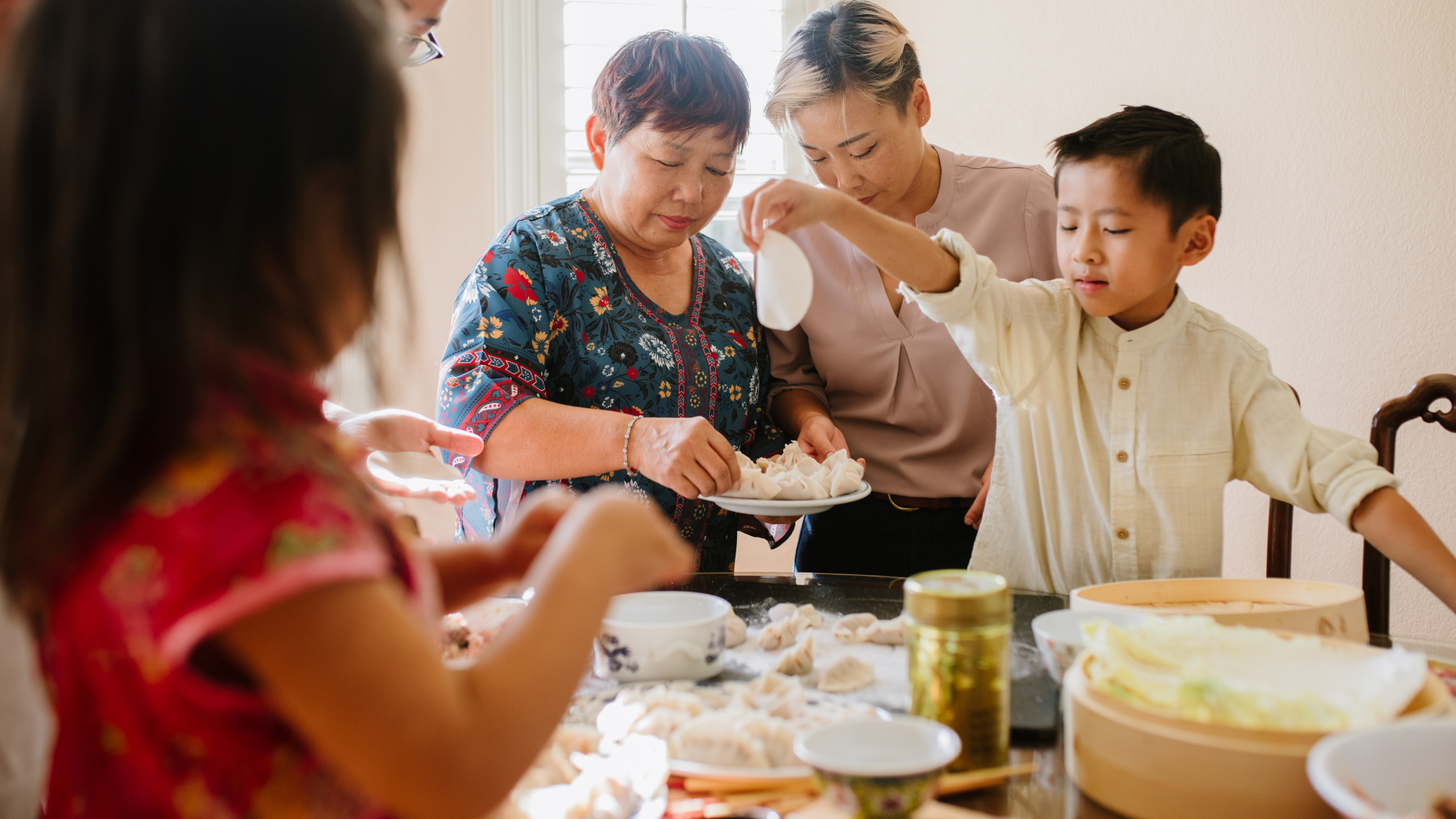
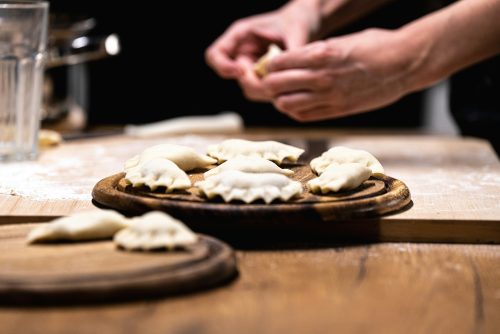
“My parents would hold a potluck party with family friends, and the central activity would often be folding (then eating) dumplings and pot stickers. I think this was usually around Thanksgiving and the Lunar New Year. [Also] when I was a kid, I’d always say ‘wan an ming tian jian’ to my parents, ‘Goodnight, see you tomorrow!’” — Yiling W.
“Anxiety and paranoia.” — E.C.
“Before each Lunar New Year meal, everyone must have taken a shower to wash out the end of one year and begin a new year clean. Chopsticks cannot be dropped during the meal. If dropped, it would bring bad luck, so everyone needs to make sure chopsticks are on the table at all times. Around the house, my mom usually cleans before the end-of-year dinner. All debts must be paid in full before the end of the year so that the new year will be a clean start. My mom usually makes us a package for the new year: one red envelope under the pillow to bring good luck. I used to do this as a kid, but since becoming a Christian, I ignore it. Another packet will be in a ziplock — a red envelope with a tangerine and some lucky candy. This is to be put in the car to bring good luck for the year.” — Suzanne Kanyavong
“I think the most consistent one I can think of right now is the bowing for New Year’s, which we do on January 1st instead of Lunar New Year, since we came to the States.” — Caitlin Choi
“My parents were big on assimilating us kids, but I experienced Filipino culture a lot through food — pancit, adobo, sinigang (tamarind-based soup), and other things I didn’t care for as much (kare kare — peanut dish, for example). Once we were old enough, we helped my mom make gyoza (Chinese recipe from my dad’s mom) and egg rolls, and we joked that we were ‘mama’s little sweatshop.’” — Melissa A.
“Taking our shoes off at home, going to Chinese school as a kid to learn the culture and language, taking our parents in when they are older versus putting them in a home.” — Melanie P.
“Not a Chinese American tradition, but my family gives Thanksgiving presents instead of Christmas presents, which we still do today! And my sisters and I do that with our kids, too. We always have Chinese sticky rice stuffed inside a chicken for Thanksgiving dinner. We never go visit someone’s house without bringing something like oranges. And take shoes off in every house. Kidding about the oranges. But we do always have to bring something — usually food.” — Abby Low
“I am Chinese, but born and raised in the Philippines, so I’ll share some cultural traditions from both: From the Philippines, ‘Mano po’ is a gesture of respect that involves a younger person bowing and pressing the back of an elder’s hand to one’s forehead, usually done when entering an elder’s home or seeing an elder in a gathering. Food and family is very big. Boodle fights is a traditional, communal meal shared on a long table covered with banana leaves. From Chinese culture, wearing red attire when attending someone else’s birthday party or when celebrating the Lunar New Year. The married couple gives red envelopes to an unmarried person on Chinese New Year. The younger person reciprocates by accepting the red envelope with both hands (never with only one hand). This shows gratitude and respect to the giver. Eating noodles when celebrating someone’s birthday (indicates long life), fish and dumplings during Chinese New Year (indicates sufficient wealth/prosperity, surplus).” — C.R.


