

Beyond Mangoes and Saris in Nina McConigley’s Postcolonial Revenge Novel

Author Nina McConigley discusses her latest novel, “How to Commit a Postcolonial Murder,” exploring how she decolonizes Western storytelling and navigates the fractured identity of the Indian American diaspora.
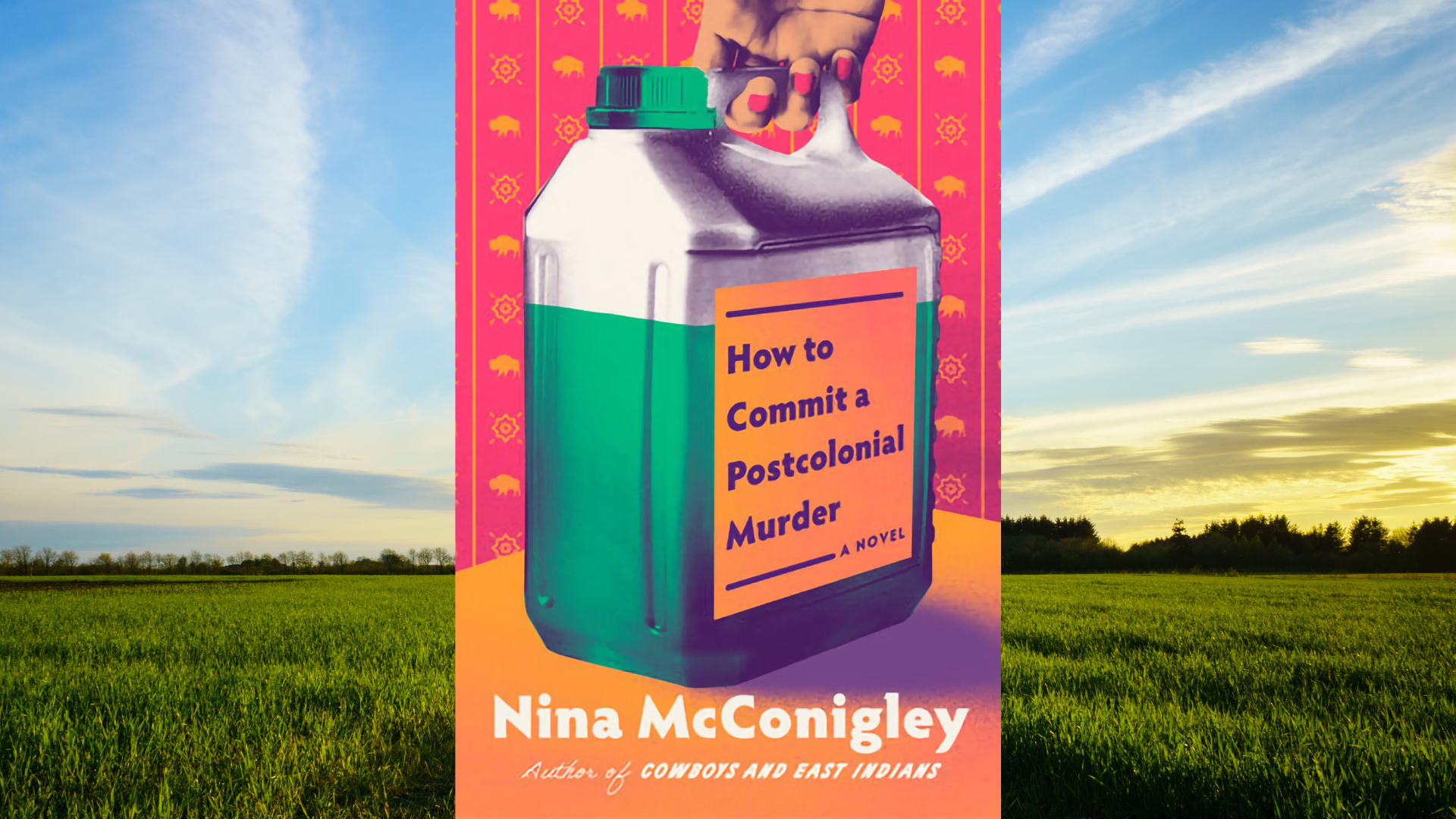
For many in the diaspora, one’s identity can feel like a fractured mirror: a “double consciousness” born from seeing oneself through the distorted lens of a dominant culture juxtaposed with the truths one holds about oneself. Nina McConigley’s latest release explores that sense of splitting through the character of Georgie Ayyar Creel, a biracial Indian American 12-year-old growing up in Wyoming.
In “How to Commit a Postcolonial Murder,” set in the 1980s, Georgie and her older sister Agatha Krishna plot to kill their uncle. But it’s not just Georgie’s biracial, diasporic upbringing that contributes to her fragmentation; it’s also the trauma, secrets, and shame that result from her uncle’s abuse.
Breaking the “Brown-Person Story” Mold
Georgie’s narration is immediately arresting with its wholly original, slicing wit. In the first chapter, she turns her gaze directly onto the reader, addressed as “you,” and gets some things out of the way: This book won’t be about mangoes, saris, spices, or Hinduism. Readers know they’re in for something different when Georgie concludes, “Does it make me angry that you need all of these specific details to feel like you’re reading a proper brown-person story? Yes.”
McConigley reflects that during prior book club visits for her debut short story collection “Cowboys and East Indians,” readers often asked her very stereotypical questions about India regarding food or poverty, so she wanted to address those expectations at the very beginning of “Postcolonial Murder.”
“I felt so tired of why people want this performance of Indianness and also this performance of Wyoming,” she says. “People exoticize in a lot of ways, not just Asian culture.” By breaking the fourth wall and directly confronting the reader with their own biases, McConigley hopes to proceed with the novel on her own terms.
As Georgie states, “Now I can be free to tell you the story I want to tell you, in exactly the way that I want to tell it.”
McConigley’s Path to the Page
A fiction writer as well as playwright, McConigley is known for creating plots that unravel the immigrant experience in rural settings in America. McConigley’s path to writing “Postcolonial Murder” in exactly the way she wanted to tell it was not always immediately clear. Only after college, when she was working at an insurance company and feeling like her “soul was being sucked out,” did she take her first creative writing class in the evenings. “It was the thing that saved me that year,” she reminisces.

Once she recognized her love for writing, she went on to get an MA in English and then an MFA. Because both McConigley’s daily context and the publishing world are so white-dominant, she has intentionally sought out writing mentors and colleagues who are Asian American. For her MFA program, she chose to go to the University of Houston to learn from the Indian American writer Chitra Divakaruni so that she wouldn’t have to explain herself or her culture during workshop sessions, where classmates read one another’s work and give feedback.
“A lot of workshops exoticize your work, and it was so nice to not have that, to have a teacher who cut that off,” she says.
Her first short story collection took two years to sell, with many publishers telling McConigley that they wanted a novel from her instead. In the aftermath, she tried writing a novel, with many false starts. It wasn’t until she divested from the idea that a novel had to be a physically big book that she was able to run with her idea for “Postcolonial Murder.” She found her “guiding lights” in British writers known for short but powerful novels such as Natasha Brown’s “Assembly” and Max Porter’s “Grief is a Thing with Feathers.”
With this in mind, she decided to try writing about a year in the life of Georgie and Agatha Krishna. “I started writing for myself in a different way and felt a lot of joy,” McConigley recalls.
Finding the Language for Survival
Indeed, in fewer than 200 pages, “Postcolonial Murder” tells a substantive, engrossing story of sisterhood, patriarchy, revenge, guilt, and absolution. Georgie’s life is turned upside down when her maternal uncle, his wife, and his son move in with the Creel family after they arrive in the United States from India.
“They came at us like moths,” Georgie explains. “Fast, a little frantic, and seemingly, as the months would show, drawn to all the wrong things.”
Georgie’s tight bond with Agatha Krishna starts to fray as both girls are subjected to actions that they can’t find the words to speak about. Instead, they talk around it, plotting vengeance against the man who has soured their home from safe to perilous. Yet even as they set their plans for justice into motion, can the sisters conceive of the cost of achieving their goals?
As Georgie writes, “To have freedom, there is always a fight. Sometimes you lose part of yourself. Sometimes you gain something altogether different from what you thought. And sometimes which side is right, and which side is wrong, gets all muddled together.”
It is Georgie’s singular, subversive voice that carries the book with the blended ferocity and questioning of a girl on the cusp of womanhood. Flitting between gallows humor and charming cheekiness, McConigley sprinkles the novel with teenage magazine quizzes, classic 1980s childhood games like MASH, and clever wordplay, such as an extended comparison between the “cast” of fishing in Wyoming and the “caste” of social classes in India.
McConigley says that to shape Georgie’s voice, she channeled her own recollections of “how playful and fun” things are at age 12. Despite having a relatively modern Indian mother, there were still things that weren’t discussed, so McConigley looked to teen girl magazines for guidance on things like tampons and shaving her legs. The upbeat cadence of those magazines help inform the tone of “Postcolonial Murder.”
Moreover, having faced countless racial microaggressions in her childhood and current life in Wyoming, McConigley reflects that “you almost have to find humor or I would be so depressed on a day to day basis.” (She was once asked if people drive cars in India.)
Pushing Back Against Western Narrative
As a teacher, McConigley feels a lot of hope when she reads her students’ writing. “They’re feeling less and less the kinds of constraints that I felt,” she notes. Although she is aware of the pressures of tradition and saving face, McConigley witnesses how younger writers act with the freedom to break from that.
In her own work, McConigley has been influenced both by her time working at a publishing house in Chennai called Tara Books and by translated literature. At Tara, which publishes a lot of children’s literature, she saw how Indian authors “tell stories in really odd, more Indian ways, and I liked that. It made me realize I’ve been taught one Western way of storytelling, and I’m pushing back more and more as I think about writing.”
Similarly, one of the books she used to teach, “Separate Journeys,” is a compilation of short stories by Indian women, many of which “are structured kind of oddly.”
“That was really edifying for me,” McConigley muses. “It made me realize that I grew up with a really Western storytelling tradition, and we don’t have to tell a story that way. We don’t have to have an ending that’s super satisfying. We don’t have to explain everything.”
As McConigley writes against these bounds in “Postcolonial Murder,” she also writes against other traditional stories. Georgie remarks, “In all the stories Amma would tell us, the girls never rose up. They accepted their fate, they married. They were dutiful and obeyed. They never killed a man.”
Whether the sisters manage to kill their uncle and whether they can find a way back to one another, “Postcolonial Murder” is a dazzling, knockout book that refuses to be pigeonholed.
“How to Commit a Postcolonial Murder” is available online and at your local bookstore. Links on this page lead to our Bookshop.org storefront, where every purchase supports both your reading journey and ours. Thank you!
You can learn more about Nina McConigley at www.ninamcconigley.com, or follow her on Instagram at @ninamcconigley.


