

Why Our Morning Coffee is a Matter of Power According to “Art of Citizenry”

Hosted by Manpreet Kaur Kalra, the “Art of Citizenry” podcast examines how power, identity, and community shape our everyday lives and collective responsibility.

Often, the most ordinary parts of our daily routine are shaped by forces larger than we realize. For example, choosing where to buy coffee can influence who profits, whose labor is protected, and which businesses survive in our neighborhoods. These seemingly small choices are deeply connected to systems of power, capital, and community.
Created in 2020 by Manpreet Kaur Kalra, “Art of Citizenry” is a podcast that explores these hidden connections.
Episodes typically run between 30 and 50 minutes and primarily feature dialogues between Kalra and community-informed guests, ranging from activists and journalists to business leaders and storytellers. Through her podcast, Kalra says that she “hopes to leave listeners with ways for them to think about: How do these issues actually impact me? And how do I engage with these issues in ways that I don’t even realize?”
The Levers of Power
Before her podcast, Kalra started her career working closely with the issues she discusses in her podcast. Working in the fair trade ethical sector, she saw that a lot of the conversations in her work were “rooted in this … very abstract understanding of what equity and justice and equality — all these very lofty terms — really mean,” she describes.
Kalra explains that she was inspired to create a space that acknowledged the “ingrained power dynamics that exist in every interaction.” Thus, “Art of Citizenry” was born.
To hone her point even closer to home, she acknowledges the level of power that exists between her, the interviewer, and every interviewee. She illustrates that the power of an interviewer lies in shaping the story, either through the questions they ask or the environment they create for the conversation. Every conversation and interaction includes a certain level of vulnerability that, as Kalra puts it, “exists on both ends.”
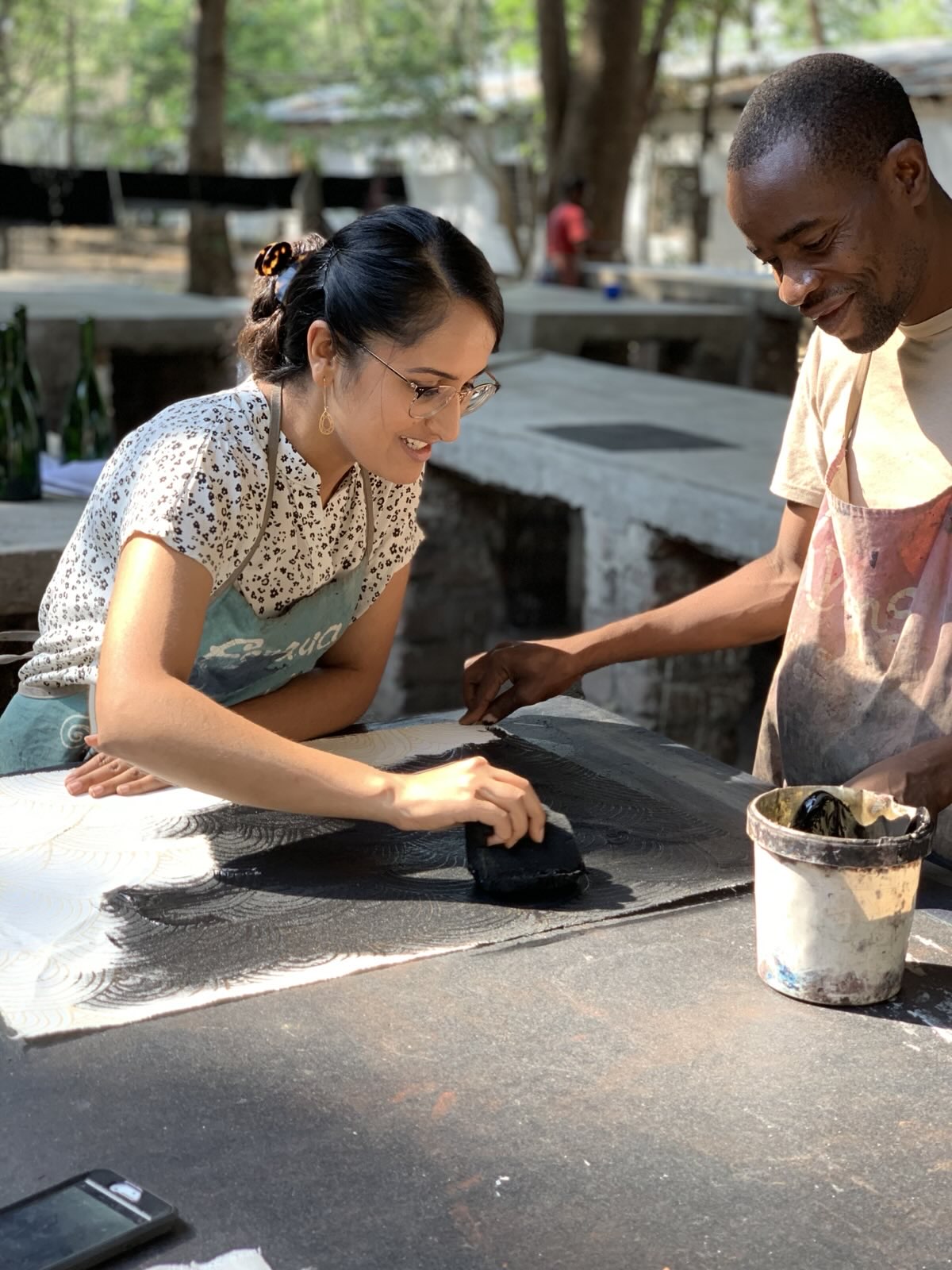
In her podcast, Kalra frames power as something fluid rather than fixed. She notes that “there are moments when we are navigating a situation from a place of advantage,” while also recognizing that the same person can be at a disadvantage in other situations.
Kalra uses the term “levers of power” — a way to illustrate that power can operate at both personal and systematic levels that come to play based on our “environment, the systems, the contexts that we sit in, [that] yield different layers of our individual experience.” She adds that under the levers of power, “all of those pieces matter.”
According to Kalra, this power framework extends to how communities of people are understood and represented. She points out that people, especially from communities of color, are often put into a box where a single story becomes an assumed experience for everyone in that community. This flattening overlooks the reality that no community is a monolith, as we each have our own unique advantages and disadvantages that shape the way we experience something.
By resisting the urge to universalize experiences, Kalra uses “Art of Citizenry” to delve deeper into the nuances she believes are missing from everyday conversations about social and political issues within different communities.
Kalra’s Identity as a Compass
The nuance Kalra finds in conversations about social and political issues stems from her own lived experiences as the granddaughter of refugees from the partition of India in 1947 and the daughter of survivors of the 1984 Sikh genocide in the country. The partition violently divided the Indian subcontinent along religious lines.
For Sikh communities in particular, their cultural and spiritual land, Punjab, was split in two. The divide left many Sikhs caught between newly formed borders, subjected to massacres, and permanently uprooted from their land and sense of belonging. Decades later, in 1984, Sikhs again were the targets of state-sanctioned violence following the assassination of Prime Minister Indira Gandhi.
Reflecting on these events in history, Kalra notes, “A big part of when you talk about the history of [the] partition or the 1984 genocide of the Sikh community in India, [is] that history has been written for us.” Her reflection became formative in how she thought about voice, power, and representation.
During college, Kalra started the first online publication for Sikh women — an anonymous platform where contributors could speak openly about issues and talk about issues that really mattered to them. She recognized early on that Sikh women’s identities are often prescribed:
“Our identities are expected of us or told to us of how we should be practicing, or how we should be approaching the world.”
Even today, she observes, “There’s no place in modern media … where those avenues exist for us to grapple with our own identities.” Creating a safe space online for those conversations felt essential because, for Kalra, there is no separation between who she is and what she builds.
Kalra’s identity isn’t something that she just brings into work, but the foundation of it, shaping all her decisions and conversations. The same questions that drove her to create space for Sikh women are also the ones that underpin her podcast.
Mastering the “Art of Citizenry”
If Kalra’s earliest work focused on creating spaces for voices that were erased, “Art of Citizenry” is an expansion of that project outward. The fully independent podcast offers raw and honest conversations that examine how communities relate to one another, and how histories and current events shape the way we show up.
Since the podcast asks broader questions about collective responsibility, language matters deeply to Kalra. She admits that she “really grappled with the name over the years,” particularly because the term citizen is “so loaded now” and, as she notes, always has been.
For Kalra, citizenry isn’t about legal status or borders. Instead, citizenry is about the way that we relate to one another. “When I think of the ‘Art of Citizenry,’” she explains, “citizenry is about how we come together as people and how we interact regardless.” She resists the idea that borders should dictate how we engage with the world. To her, borders are human-made, and issues facing one region will inevitably “feed into the issues that are happening across borders,” she adds.
Kalra hopes her listeners will be able to see how social and political issues are impacting the way that she engages with the world and others. In her view, too often, people dismiss social and political issues as irrelevant — thinking “that’s not my issue, that’s not directly impacting me” — when in reality, all these things are interconnected.

The podcast approaches citizenry as a practice, rather than a designation, rooted in community, reciprocity, and trust. To think about citizenry is, as Kalra explains, to see “the collective humanity that exists in each of us.”
For listeners, the podcast is both an invitation and a roadmap to see the world differently, understand how issues intersect, and start to engage as a more informed citizen — starting with something as small as your morning cup of coffee. What matters most to Kalra is that her listeners break free from the same talking points that dominate public discourse, reflect on their own lives, and create space for more thoughtful conversations.
Find more about and support the “Art of Citizenry” on the podcast’s website and Substack. You can learn more about host Manpreet Kaur Kalra on her website.
