

Reminiscing on the Quiet Romance of Celine Song’s “Past Lives”

Writer and director Celine Song discusses the silences, first love, and learnings that make up her debut film “Past Lives.”
Note: This article contains spoilers for “Past Lives.”
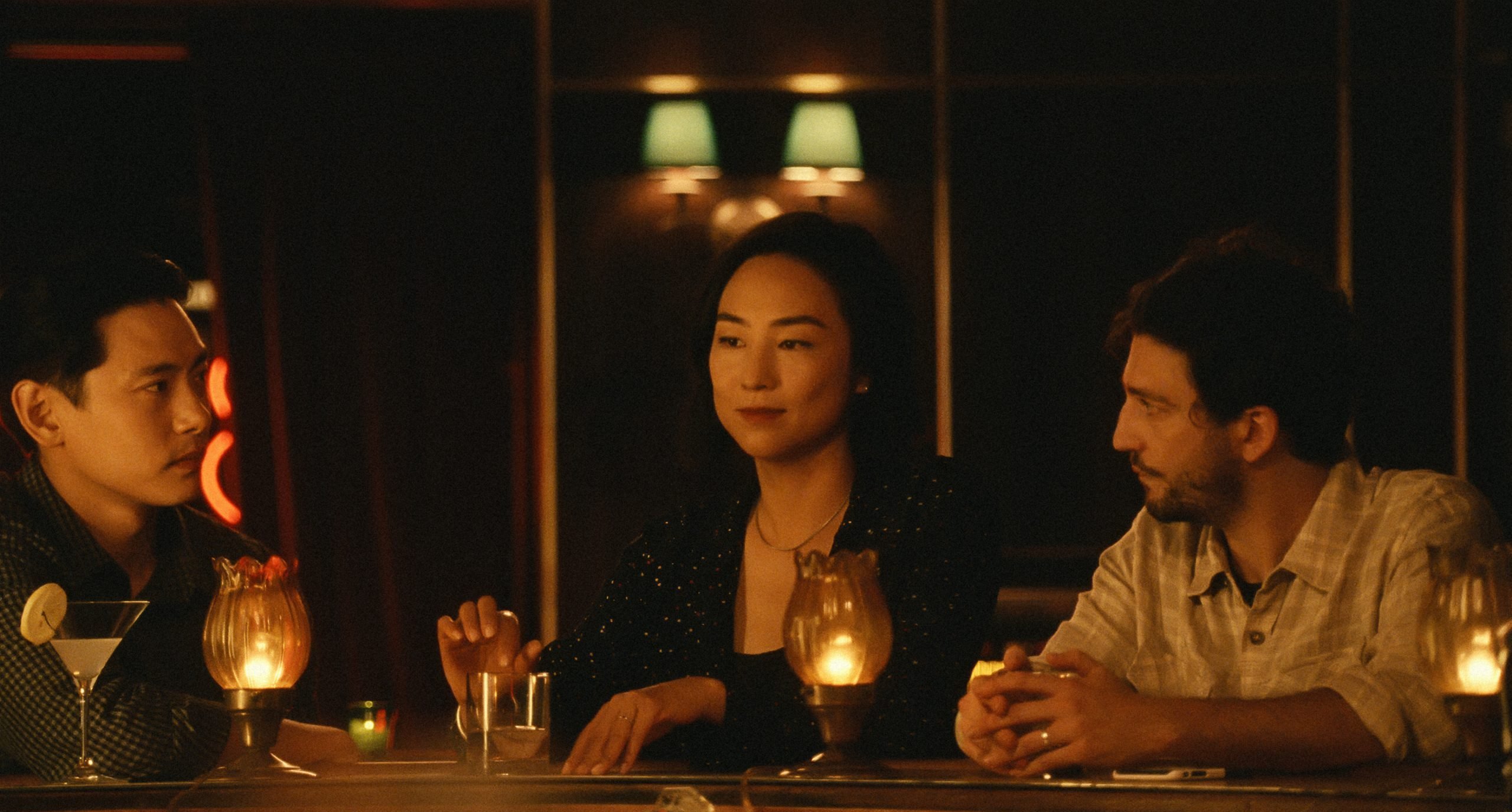
The movie “Past Lives” (A24, 2023) begins in a bar. An Asian woman sits between two men — one Asian and the other white. A man and woman off-screen ponder the trio’s relationship with one another. Who are these strangers, and what are they doing in this bar? Perhaps the Asian man and woman are a couple, and the white man is their tour guide. Or are they siblings?

Celine Song, the writer and director, takes this scene from her own life when she finds herself sitting between her childhood sweetheart and her husband one night. While the opening scene helps draw in the viewer’s curiosity about these three characters with a little bit of humor, in some ways, it also insinuates that even strangers have their own stories. We all are made up of our own lives — both past and present. But this story, in particular, is about Na Young and Hae Sung, a fictionalized version of Song and her childhood sweetheart, who first met in South Korea as classmates at the age of 12. Na Young’s family plans to emigrate to Canada. Before they leave, Na Young expresses her crush on Hae Sung, and her mother sets up a date for the two. On their last day together, the two pause before going their separate ways — Hae Sung disappearing down the paved path on the left and Na Young taking the stairs on the right. ‘
Twelve years later, Na Young, who now goes by Nora (played by Greta Lee), studies in New York City, while Hae Sung (played by Teo Yoo) still lives in Seoul. By chance, the two reconnect through Facebook and rebuild their friendship through Skype calls, though this is short-lived, as both pursue their own passions and the two lose touch again.
Flash forward once more. After twenty-four years since Nora and Hae Sung met as children, the two reconnected in person in New York City. Nora, now married, lives in the city with her husband Arthur (the white man from the bar, played by John Magaro), while Hae Sung comes to visit on vacation, having recently broken up with his girlfriend. After spending a few days together, this brings us back to the opening scene, the night at the bar, as the two sit with Arthur and discuss their relationship.

Silence Speaks Louder Than Words
As the film progresses, we learn more specifically about Nora and Hae Sung at these three stages of their lives, over the course of these 24 years together and apart. The two reveal bits about each other through dialogue, which takes place in English and Korean. But while dialogue is important in this film, so is silence. There are moments in the film where Nora and Hae Sung literally just look at each other for minutes on end without any words, but these moments are monumental. The movie culminates in such a scene as the two stand on the curb in the middle of the night, waiting for Hae Sung’s Uber to take him to the airport, with a flashback to their first goodbye as children in Seoul. It’s probably the most emotional part of the movie and feels heartbreaking and almost suffocating.
“There are so many moments in our lives where silence does speak louder than words,” says Song. In order for silence to be effective, it needs to be contextualized and clear about what it’s about. She brings up the speakeasy scene at the end as an example. “Everything is going to be spoken in that scene so that when we are in the silence, we know what the stakes are. We know what we’re thinking about when we’re in that silence, and we also know what the characters are thinking about in that silence.”
That’s contrasted with an earlier scene between Nora and Hae Sung as they walk around Brooklyn when the silence tries to convey their curiosity about each other. What was most important for Song was whether the silence would be clear or muddy in its intention. “It’s more a matter of, what’s the point of this silence as opposed to should there be silence.”

Other juxtapositions feel intentional in developing Nora and Hae Sung as characters. Of course, there’s the distance between New York City and Seoul and the role this plays in developing the two characters’ identities as a Korean man and a Korean Canadian woman. There are callbacks like the running joke that, as a child, Nora is a crybaby. Though, twelve years later, when she suggests that she and Hae Sung should stop talking for a while, the latter seems more visibly upset. While Nora is based on Song, it’s a little funny that the writer seems to hold in the most during the film, only releasing her emotions after the two say goodbye — compared to the engineer, who seems more consistently expressive, though shy. When the two see each other in person for the first time in New York City, Nora initiates the embrace between them. But when Hae Sung’s Uber pulls up the following night, the roles reverse, and it’s he who pulls her in for a hug.
The Romance of Potential
“Past Lives” characterizes itself as a love story. But most of the time, it doesn’t feel like one in the traditional sense that these two people are meant to be. Though there’s a lot left unexpressed through words between Nora and Hae Sung during their in-person interactions, the two’s relationship feels more platonic than romantic. The feelings between the two feel weird even. Perhaps, it’s because, throughout the film, a romantic relationship never fully comes to fruition at any point.
Nora tells her husband at one point, “He was just a kid in my head for such a long time. I think I just missed him.” Though Nora and Hae Sung hold specific memories for each other, it’s clear that the two have different ambitions, values, and conflicting identities. While Na Young still feels real to Hae Sung, to Nora, that part of her was left behind at age 12 when she immigrated to Canada. Because of that, the two will always, in some ways, be strangers to one another. Perhaps, it’s simply, as Nora says in the bar, that last night, the two didn’t have enough in yun.
In yun (인연), and even the fascination around first loves is a very Korean, or East Asian, concept. The former, Nora explains, comes from Buddhism and translates directly to providence, or fate, to describe the relationships between people. In the 2016 K-drama “Guardian: The Great and Lonely God,” the term isn’t expressly mentioned, but one of the subplots (warning: spoilers) involves a young king and his wife, who continue to find each other, even through reincarnation — meeting in each subsequent life until they can be together happily. And in plenty of other dramas, a character who can’t seem to let go of their first love seems to be common. It’s this allure that spawned the story behind “Past Lives,” too.

Song recalls working with the actors who played Hae Sung’s friends in the film. As part of their auditions, she asked them to ad-lib by giving Hae Sung advice on whether or not he should go and see his childhood sweetheart. “Every actor that I brought in who was a Korean guy, they all said, ‘You should go and see her just one last time in New York,’” Song remembers. “I was like, ‘Whoa’ because I think if you asked Americans, even Korean Americans if you should go and see the girl in New York and fly 14 hours to see your first love, they would say, ‘What are you talking about?’”
Because Song grew up in Canada and has lived in New York for a while, she doesn’t quite understand the fascination of first love. “Do you?” she asks me. “I feel like in a lot of K-dramas, it’s like you’re not the love of each other’s lives if you didn’t know each other as children. But I actually am somebody who is more interested in the last love. Who do you die with?”
Maybe first love and in yun make for the perfect combination to tell this story. Even Nora’s husband Arthur remarks, “What a good story this is,” and jokes about him being the white villain. Though I felt some pity for Hae Sung during the film because of his attachment to his first love, there is something inherently romantic about the potential and layers between two people, and maybe a first love holds so much of that potential.
“If you leave something behind, you gain something, too”
Though the relationship between Nora and Hae Sung throughout the film feels muted, the repressed emotions build up to a bittersweet ending that makes Nora cry. I can attest it’s hard to leave the theater with a dry eye after watching this movie. As much as “Past Lives” is about potential and the “what ifs,” it’s also about loss — of childhood, of people you knew, of previous versions of yourself. But there’s something hopeful that rings true throughout the film, too. As the two kids play together at the film’s beginning, Nora’s mom tells Hae Sung’s mom, “If you leave something behind, you gain something, too.”
There’s a lot more that can be dissected in “Past Lives,” but I’m running up against my word limit. For example, Nora’s relationship with Arthur suggests that in yun may bring two people together, but love also constitutes a series of choices that people make. Even Hae Sung’s decision to seek Nora out on Facebook and in New York raises questions after he mentions that he thought about Nora while he was in the military — and only came to New York after a recent breakup with his girlfriend.

Identity, too, adds such a crucial layer in “Past Lives,” but at this stage of her life, it was less of a revelation for Song when she wrote the film. “That was something that I became very at home with in my 20s,” she says. And you see it in the film, too. Nora in her 30s, is self-assured and confident in who she is as a Korean Canadian. Rather, this film, Song’s directorial debut, was more of a discovery about herself as a creative person. “If there was a limit I thought I had, it was always being pushed. I was more capable of things than I ever thought — of working with people so deeply. And it was purely a discovery that I was a filmmaker, which was cool.” That in itself seems to be another gain from this experience.
“Past Lives” is now playing in theaters. Watch the trailer here.


