“Joy Ride” Expands Definitions of Family and Navigates Complexities of Identity

Adele Lim’s directorial debut is a chick flick, raunchy comedy, and Asian American movie all in one. The story thrives because the film isn’t focused on being more than it is.
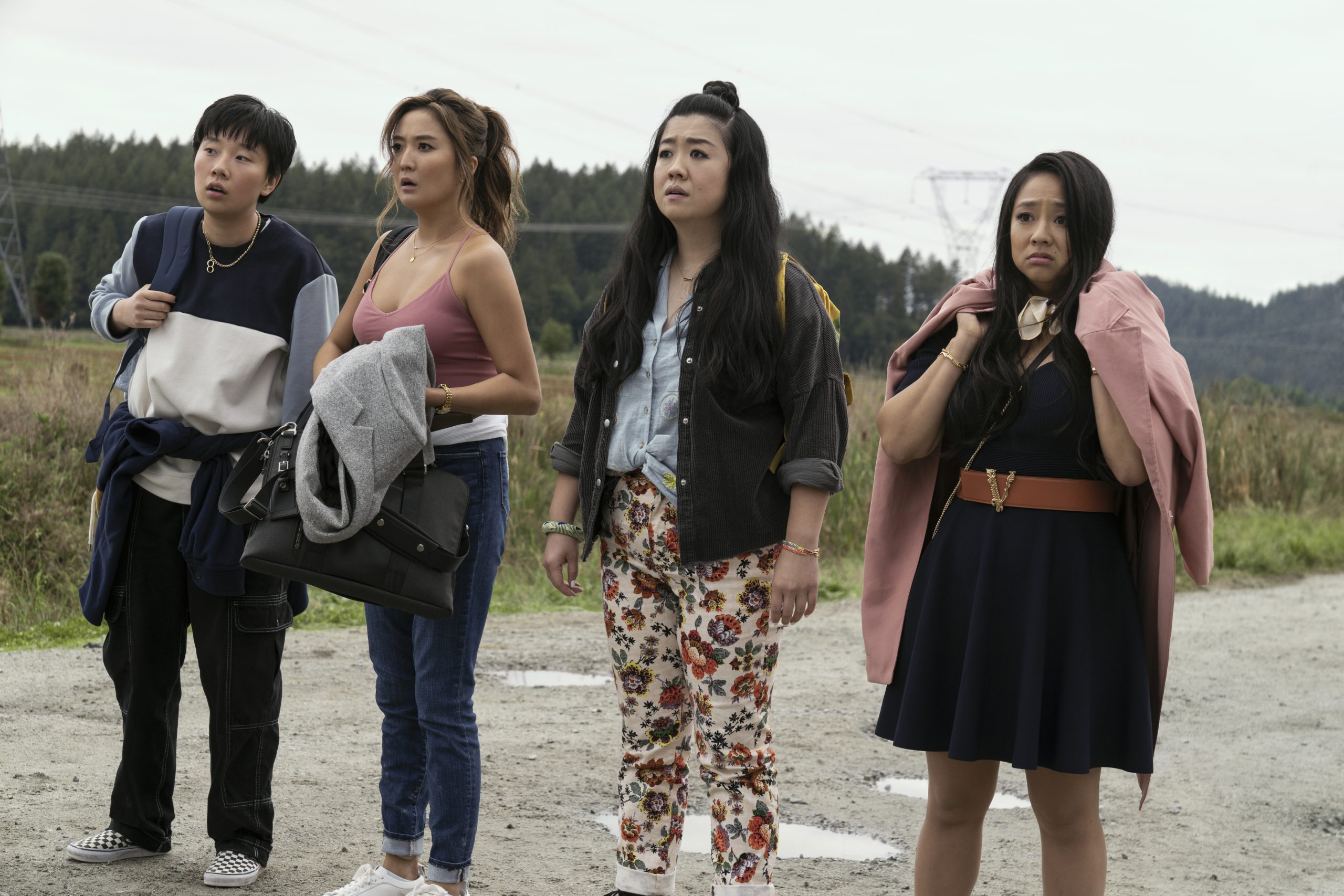
Films that don’t explicitly try to represent a community are usually the ones that raise the standards for films that try to do so. In Lionsgate’s film “Joy Ride,” transracial adoptee Audrey (Ashley Park), goes to China for a business turned personal trip to find her birth mother with her friends. They end up on an unexpected joy ride, and as Audrey’s unknown past starts to interfere with her pre-planned future, she is forced to reckon with how she values her self-worth and friendships.
Connection Over Representation
“Joy Ride” screenwriters Cherry Chevapravatdumrong and Teresa Hsiao only sought to make an absurdist raunchy comedy, happy for people to connect with the story. This sensibility comes under the direction of Adele Lim, the co-writer of “Crazy Rich Asians” — an exceptional film that became the pinnacle of 2018 Asian American representation. “We’re writers, directors, actors. We don’t wake up in the morning going, ‘I want to create a project for representation,’” Lim said in a press conference.
The authenticity of the film shines in the friendships shown to the audience when Audrey goes on her business trip with Lolo (Sherry Cola), Kat (Stephanie Hsu), and Deadeye (Sabrina Wu). Instead of directly showing the audience the difference between Audrey’s adoptive white parents and Lolo’s Chinese parents, a montage shows how Audrey and Lolo’s friendship over the years was not always centered around their otherness as two Asian girls in a predominantly white town. We can relate to the girls desiring different career paths, but still staying as best friends while having their own individual tastes and styles.
Shifting the Focus Away from Romance
The film also breaks boundaries by not being centered around romance, and choosing to focus heavily on the female and nonbinary characters. While Audrey is discovering her roots, Kat, Lolo, and Deadeye already have their own fully developed character arcs. Though the characters and story were strong due to their clear progression, it was Deadeye’s development that stood out the most.

For example, Deadeye, a nonbinary K-pop enthusiast, finds strength in their chosen family because they don’t feel accepted by the general public. Audrey finds Deadeye socially awkward, the group doesn’t always understand Deadeye’s humor, and Deadeye uses a preferred name, not a given one. One of the most moving performances of the film came when Deadeye explained why they like K-pop, “You know why I like K-pop? Because it likes me back.”
The story comes to a climax when the friend group have lost their passports and have to find a way to fly from China to Korea. Up until this point, Audrey, Kat, and Lolo would get annoyed or confused by Deadeye for their unusual humor and occasionally immature behavior. However, it was Deadeye who was able to solve the group’s unsolvable problem. Deadeye’s ability to come up with a creative solution comes from the fact that they don’t fit in. The group only fully accepted Deadeye once Deadeye was able to solve a problem for them. This shows a kind of conditional love in the friendship, or it could be seen as the moment when the group finally gained confidence in Deadeye.
Although Wu’s performance gave Deadeye the charisma the character needed, they were often the butt of the joke and used as comic relief. For example, when the three women were fawning over Kat’s fiance, Clarence (Desmond Chiam), the camera pans over the women’s wistful faces and ends with Deadeye’s indifference to him. At one point in the film, Deadeye jokes that they are peeing standing up with a hose in their hand, the type of comedy typically deferred to men. Of course, the other characters also served as comic relief, especially Kat and her tattoo, but it was Deadeye’s otherness that was centered for comedic purposes.
Deadeye is able to break through the conventional mold because of their outcast perspective. Although a non-heteronormative character is used as a plot device, Deadeye still shows character development. By the end of the film, they’ve accepted their difference and embraced it rather than feel restricted by it. Their perceived weakness of being weird or eccentric is used as their strength, and they gain acceptance by the group once they help the “normal” characters.
“Joy Ride” relies on non-heteronormative characters to awaken others. On one hand, this might be progressive because Deadeye’s character is fully fleshed out. On the other hand, they may only be accepted by the group after they served their purpose.
Redefining Family
In the past, Asian American movies had the pressure to focus on tropes like family defiance, specifically choosing a lover your family didn’t approve of. Although films like “Mississippi Masala” and “Saving Face” do this exceptionally well, contemporary films expand the Asian American label and are not constrained by it. Creating a movie with the intention of solving a representation issue can lead to the concept of “falling into the white whale” that minority media is inadvertently trapped in. By staying on theme with the raunchy comedy genre, “Joy Ride” was able to expand the category of Asian American media and chick flicks that viewers may be quick to be close-minded to.
Instead of being about a traditional family, “Joy Ride” is about the chosen one, which feels experimentally appropriate for a transracial adoptee’s narrative. It’s fitting that while Audrey accepts her adoptive parents and is questioning her relationship to her birth mother and birthplace that is China, she still has her chosen family supporting her throughout the journey. At first, Audrey is reluctant to find her birth mother because she’s happy with the family she already has. It’s her childhood best friend Lolo who pushes Audrey to find her birth mom, and soon Audrey embraces the complicated process. Audrey meets Lolo’s family in China and feels loved by them. She’s open to trying traditional Chinese foods she normally doesn’t like and questions if she would’ve fit in better had she grown up in a homogenous society. This redefines what family means to Audrey on multiple levels.
Reinventing the Transracial Adoptee’s Narrative Successfully
The filmmakers could’ve easily felt pressured to make a feminist, anti-racist, and anti-capitalist take on a transracial Asian American adoptee’s experience, but it focuses on being an R-rated comedy first. For a topic that is often framed as serious or heart wrenching like transracial adoption (think Garth Davis’ “Lion” or Nicole Chung’s “All You Can Ever Know”), the film “Joy Ride” adds tasteful humor to the theme. With a diverse set of writers, the cultural commentary comes into the film naturally and doesn’t feel heavy handed. The best way to join the audience members roaring with laughter over the friend group’s hilarious predicament of being trapped in a train car with a drug dealer or how they ended up getting a ride from a professional basketball team, will be in theaters.
“Joy Ride” is now playing in theaters. Watch the trailer here. Learn more about “Joy Ride” here and follow the movie on Instagram at @joyridemovie.