Audrey Nuna Shows Her True Self at Jaded’s SXSW Showcase

At SXSW, rapper and singer Audrey Nuna shares how authenticity, details, and community play a role in her work and who she is.
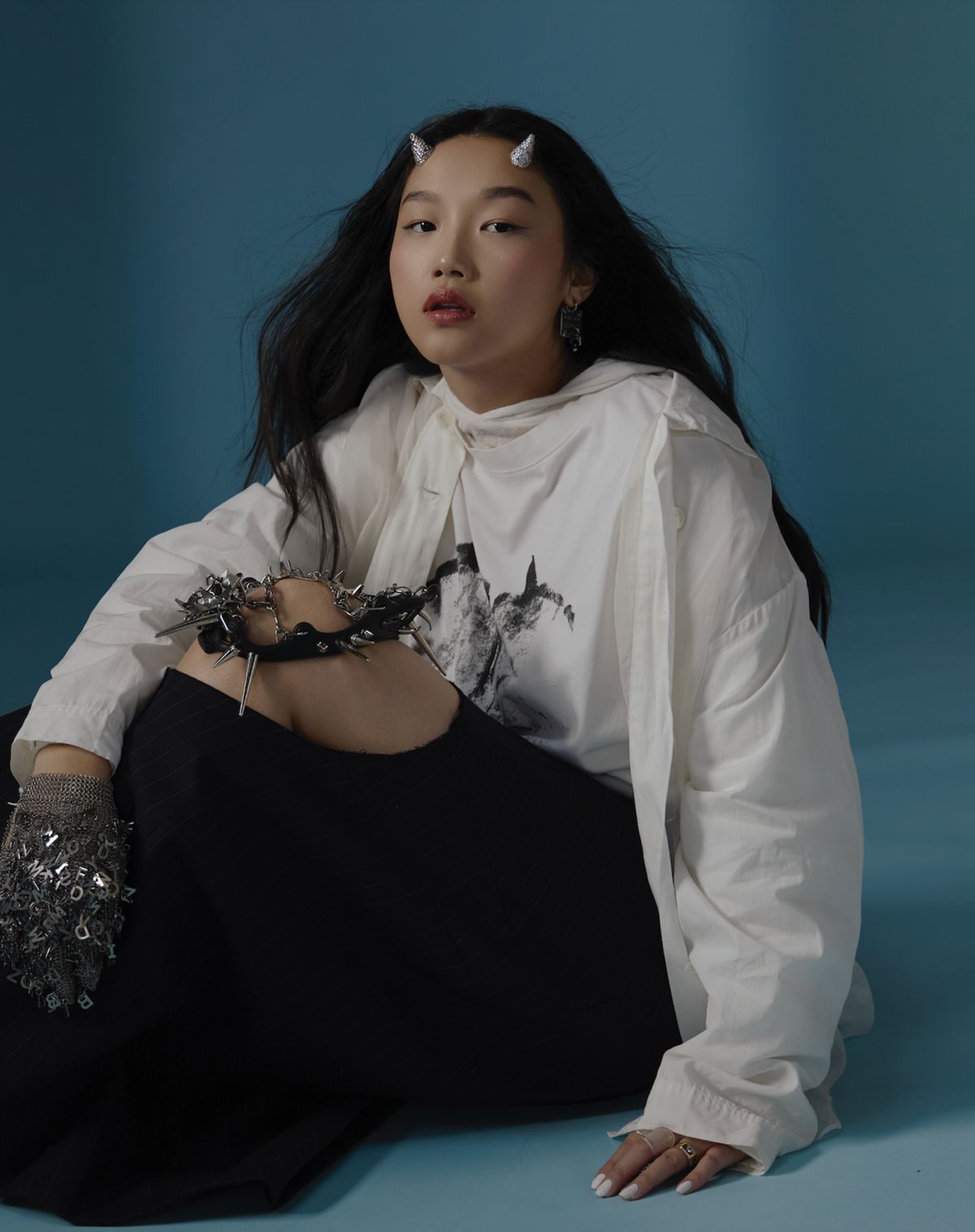
In the middle of a cloudy Friday afternoon, hours before her midnight set, Audrey Nuna and I are both sitting in an outdoor backstage-slash-alleyway of the Empire Garage in downtown Austin, Texas, on the penultimate day of SXSW. The music festival portion of the event is in full swing all around us. It’s both our first times at the event, so understandably, it’s a little overwhelming. Audrey, whose last name is actually Chu, explains that she was supposed to perform at the festival in 2020. But the day after she was booked, the event was canceled because of COVID. Tonight, she tells me, is her full circle moment.
Just Being Audrey
Even before meeting Audrey in person, I can tell she’s the epitome of cool (though in her song “Cool Kids,” she might disagree). If I try to use the words “fire” or “sick” to describe things, I sound like a try-hard millennial. But with Audrey, everything about her — her way with words, her sense of style, her music — all feels chill and organic. She’s serious but open, a little out there but still down-to-earth, effortless but thoughtful. It’s almost intimidating, but that’s just who the singer-rapper is: She’s never trying to be anyone but herself, which feels rare for someone so young in the music industry.
Right off the bat, we talk about her Korean American identity. “Being Korean American, all the experiences I’ve had in my life, everything informs the stuff that I make,” she acknowledges. Some of the connections are a little more obvious, like in her song “Blossom,” where she includes a recording of her grandma speaking Korean at the end. Audrey recalls being at a barbecue where her grandma started sharing her war stories, and Audrey realized she wanted to capture it. She found that the recording fit the song’s theme of growing up, as it spoke to her grandma’s own maturing she had to do during that time. But other instances aren’t as apparent — perhaps it’s just what the singer-rapper experiences on an everyday basis as an Asian American.
“Even 10 years ago, I think a lot of people felt like they had to [lean into their Asian American identity] in order to have a career, because that was the only angle to bypass the gatekeeping. But I feel like now with the internet, there’s this complete ‘fuck you,’” she says. “We can all just be who we actually are and not have to appease [people and say], ‘Oh, this is an Asian American singer who writes about her Asian American experience.’ I feel like that’s something that was externally put on us and now that’s gone.” To her, so many figures in the Asian American community are defying stereotypes now.

In fact, Audrey herself has been described as “one of the first female Korean American R&B acts breaking into mainstream culture.” She mentions that she’s honored to be a part of this “dope” wave of Asian American artists, particularly women. Asian American women have spent a long time being told that they need to be or behave a certain way, even within their own cultures, she reflects. But now is the time they’re breaking out of that mold. “We’re living through this time where we’re finally bouncing back from that and having this crazy renaissance, resurgence from that suppression.”
Audrey references her grandma again, who when growing up in South Korea wasn’t required to be educated. In current times, she appreciates that she has the option to be independent. Instead of overthinking her position, she’s just thankful that she gets to do what she loves. “It’s a really good time to be an Asian American woman, and I feel grateful for all the people who had to lay that groundwork and go through all the really, really suppressive shit. I just feel like we’re at a tipping point, you know?”
Her gratitude for being able to live in this moment influences Audrey’s desire to be authentic — “a commitment to just being the most honest and [to working] hard and [trying] to just do it right,” she says. This comes through in her work as a multi-genre artist, too. “I’ve always just come from a place of doing what I feel like in that moment. [I’m] trying to also learn how to balance that very impulsive style of making shit with world-building more and trying to be more [of a] project-based, content-based, story-based artist,” she describes. Just like people are breaking free of the “Asian American” label, Audrey sees the present moment as a point where artists are transcending genre. “You can really do whatever you want. You can also be a visual artist, recording artist, and producer. We’re just entering this bionic age where we can do whatever we want.”
The Devil’s in the Details
Audrey tells me that ever since she was a kid, she was really into the small details — the hyper-specific Crayola colors in the crayon box, the font on a bulletin board she remembers from second grade. She considers herself a very detail-oriented person, which guides her through the world. Maybe that’s what adds to the overstimulation as we’re talking. But it’s what allows her to make references to the Bible in one line of a song, and then switch to dropping streetwear references in another. Her goal is to pinpoint a feeling with these particular allusions.
“I think a lot about the micro shit — like I think a lot about ants, and I think a lot about those little ecosystems that exist everywhere at all times,” she remarks. “Tapping into it sounds kind of crazy, but [that] tiny attention to details really inspire me.” She mentions that she really loves artists like Radiohead and filmmakers like Denis Villenueve, who directed the “Dune” films. Attention and commitment to detail feed her creatively.
“When my brain visually gets stimulated by a sound, I know I love the song, [like] if I’m making a song and I see the video treatment in my head, or I see visuals,” the singer-rapper says. “I feel like they grow together.” Sometimes that can be a little chaotic and disorganized, she admits. But in the end, music and visuals are simultaneous — two sides of the same coin. “I feel like all creativity is made of the same thing and it’s just how you choose to sculpt it.”
Because we live in a fast-paced world, a lot of the small things can get overlooked, Audrey remarks, “But the small things ground me and [make] me feel less overwhelmed,” like grounding yourself in the middle of a panic attack. “All we have are the small things, in a really weird way … When you think so big, a lot of times, the only place that leads me to is oblivion, personally,” she continues. “When I can focus on what’s in front of me, like the shape of this leaf, or the sound of this snare that I’m going to use, or the verse on this one song, that just helps me stay sane.” She pauses. “I sound like a crazy person, but it’s because I am,” she laughs.
Finding Her People
Despite Audrey’s “IdgaF” attitude, she values community deeply. For her SXSW performance, she mentions she’s excited to play with friends — a fun coincidence, given that the showcase she’s performing in is called “FRIENDS: FOREVER,” put on by Jaded, an entertainment company dedicated to Asian youth culture. The night before, Vietnamese American artist thuy (pronounced twee) headlined. But tonight, the singer-rapper opens for South Korean indie rock band SE SO NEON, who she met while visiting their home country. In the neighboring Empire Control Room, her friend South Korean DJ Arexibo will close out the night.
“It’s fun to do this communal type of showcase,” she mentions. After all, it’s not easy being in the music industry. The singer-rapper admits that a lot of the stereotypes you hear about the business exist for a reason. “I have grown more from my relationship with the music industry from possibly any relationship in my life. It is wild,” she says. But her saving grace comes from having really close trustworthy people to keep her in check. “There’s actually so many more Asian Americans in the music industry out here than I realized. Having their support and mentorship and guidance has really been such a blessing that’s saved me so many trials and tribulations.”
Though Audrey hails from the opposite coast, she currently lives in Los Angeles. LA, she describes, is a very results-obsessed place. With the saturation of the internet, so many people are trying to get into music as a quick flip.
“I respect the hustle,” Audrey says. “[I’m] just realizing that that’s not where I’m motivated whatsoever … I genuinely [make music] because I need it to keep me sane.” She often has to remind herself that she is in a business. But, “it’s my job to learn how to float and hydroplane and Aikido my way through that — like the idea of using your opponent’s energy against them.”
A large part of survival is through finding community — banding with others to accomplish that. “I think a lot of collaboration and a lot more uplifting one another is going to be the way,” she states. As she sees more of the world, she’s gotten the idea that life is like a simulation more than ever. But that realization has been freeing for her. “You go on to the world and then you realize, ‘Wow, the world is a fucked up place’ and really all we have is our connection to other people to keep us sane.”
Cover credit: Press photo Courtesy of Leeay