Han Ren Explores What It Means to Live “The Hyphenated Life”

In her book “The Hyphenated Life,” licensed clinical psychologist Dr. Han Ren presents a guide for people looking to understand their multidimensional identities.
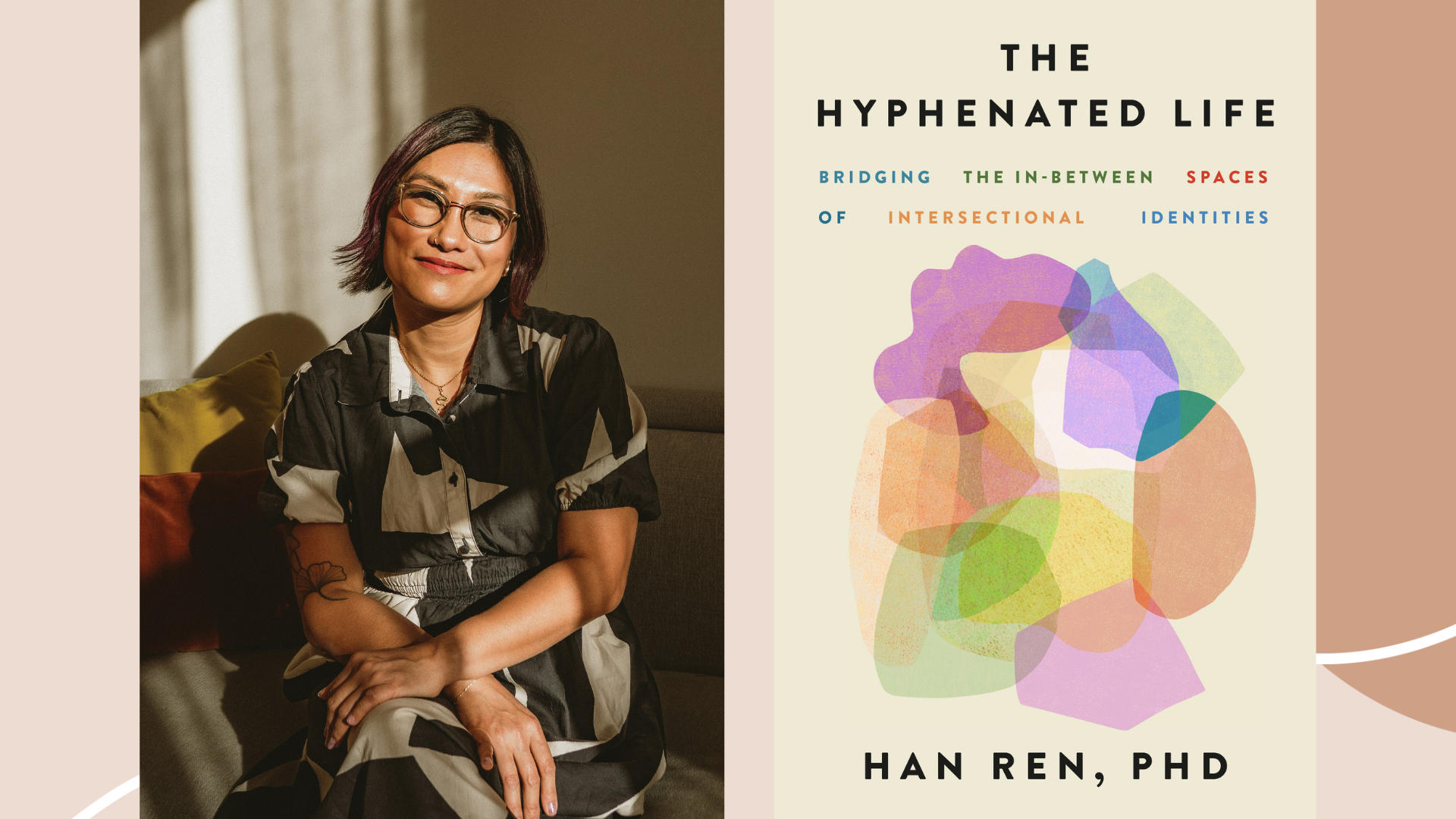
Dr. Han Ren describes her new book, “The Hyphenated Life: Bridging the In-Between Spaces of Intersectional Identities,” as niche. But perhaps it is not quite as niche as she might think, given how “Hyphenates are all around us,” as she writes in the book’s introduction.
For those unfamiliar with the term, Ren defines the Hyphenate identity as “an individual who carries two or more marginalized identity markers and is invested in navigating the in-between spaces of these identities” — different from a person who wants to conform to one identity. To elaborate, she shares some examples: “queer people in straight-presenting relationships, first-generation European-American immigrants, cyclebreaking, third culture children of immigrants … and so much more.” Hyphenates hold an inherent gap between their identity and social positionality, and the purpose of Ren’s book is to explore how to navigate that in-between space.
Ren, who is based in Austin, Texas, considers herself a “proud Hyphenated human” — a 1.5-generation Chinese American immigrant, neurodivergent mind, mother, partner, and only child. As a professional, she runs her own practice as a licensed clinical psychologist. She’s also a speaker and educator. Some even know her as a content creator with nearly 84,000 followers on Instagram and 150,000 on TikTok. And now, with “The Hyphenated Life,” she adds author to that list.
The Importance of “The Hyphenated Life”
Ren introduces her work as being “rooted in anti-oppressive liberation psychology,” using an “interpersonal, culturally humble, and systems-informed framework.” This means she takes into account factors like systems of power and oppression, community psychology, and a larger collective, and incorporates identity activism and social location in her practice.
While a client may come in to address perfectionism, anxiety, or depression, anti-oppressive liberation psychology considers factors, like generational trauma, migration stories, and colonization, “that may be contributing to the individual manifestation of systems or disorders,” Ren clarifies. “We get to empower our role, no matter where we are situated in the system, and find agency instead of trying to control outcomes.”
These ideas and frameworks are present throughout all of her work — in her private practice, content creation, and “The Hyphenated Life.” Ren writes her book with compassion, gentleness, and softness, holding grace for her audience and even the people around them. “We cannot heal if we are continually laying the blame on or condemning the people who raised us,” she highlights early on.
The psychologist references a quote from philosopher Jiddu Krishnamurti to help drive the concept home: “It is not a measure of health to be well-adjusted to a profoundly sick society.” While there are benefits to diagnoses, she doesn’t focus too much on this for her clients. Instead, she says, “I think of every single adaptation as adaptive, like, before it was a problem, it was a solution. So how can we understand that and situate it and contextualize it?”
Throughout the book, she frequently references capitalism and colonialism as external factors that Hyphenated individuals often internalize. Instead of framing concepts like masking and code-switching as negative, she refers to them as survival strategies in the face of harmful systems.
In the aftermath of the 2024 presidential election, Ren notes, “You do have to pander and find ways to play up the accessibility piece because it’s part of what allows you to survive. That seems to be true right now, but it doesn’t mean it has to stay true forever.” There’s still hope, she points out, “It’s just a different way of moving compared to when I started writing this book.”
That hope permeates throughout “The Hyphenated Life,” especially toward the close of the book. “In these wild times, it’s important to remember that the seeds of supremacy and injustice were planted long ago,” she writes, “but so were the seeds of resilience and resistance.”
Educating Two Different Audiences
Outside of her writing, most people likely know Ren through her social media content, in which she talks directly to the camera, often connecting timely topics to psychology concepts. Her personality is bright, humorous, and personable. But on social media, Ren isn’t looking to reach everyone.
When she started creating content back in 2020 to combat boredom, “there was a lot of burgeoning mental health content but [it] was all pretty generic,” Ren recalls. “I wanted to focus on the global majority, and I wanted to take a more decolonial liberation orientation to the content because nobody else was really making a lot of it at that time.” A lot of her content offers a different perspective to the Eurocentric, individualistic frameworks typically centered in mental health conversations and treatments.
Her initial goal was to create content for people who couldn’t access therapy, rather than grow her clientele. But, she acknowledges with a sigh, “As we have seen in the past few years, there’s been a drastic left turn in how therapy speak has been weaponized and the ways people get just enough … but not nearly enough depth or nuance or true understanding.” We also see people without clinical backgrounds who use therapy speak to platform themselves and profit.
At some point, Ren realized her audience on social media was other clinicians. “That’s been a really cool way to connect and have outreach and build community,” she points out. Another benefit is that other clinicians are more aligned with the content and have the appropriate backgrounds to not misconstrue her words or weaponize her content.
In contrast, “The Hyphenated Life” was not written for a clinical audience at all. With this project, Ren focuses completely on the individual. That shows through her writing, as the author balances theory with her own personal stories.
Each chapter focuses on a few easy-to-understand psychology concepts that Ren gives real-life examples for from her own experiences. Some of the terms, like trauma, may not be new (though sometimes, we need a refresher, given how overused the word has become). But sections like “Cycle-Breaking from the Trenches,” where Ren shares her own revelations of parenting her kids through reparenting herself (including a funny story about her daughter’s Rickrolling phase), feel particularly special and eye-opening, even to a non-parent. At the end of each chapter, Ren includes reflection questions and activities that are broken into “Think,” “Do,” and “Feel,” so readers can process what they’ve learned.
Ren organizes the book by spaces we occupy, starting with our families of origin before moving into school and work, and ending with broader community. Through this progression, we learn about faux cycle-breaking (i.e., superficially healing unhealthy family patterns) before we get to the actual cycle-breaking itself.
Overall, the book is not a definitive how-to, but more of a guide to give context, provide accountability, and help Hyphenates process their experiences. It’s well-researched, yet relatable, making it an easy read that audiences can continually refer back to.
Ren recognizes that this book isn’t for everyone, and perhaps that’s why she considers it so niche. People may consider themselves Hyphenates because of their intersectional identities, but Ren focuses the text largely on immigration, race, gender, and neurodivergence.
There is an infinite amount of Hyphenate identities, she says, noting other identity markers such as queerness, gender identity, relationship orientation, and disability. However, a book can only hold so much. “What may be medicine for some folks is not going to hit at all for others and that’s OK,” she concludes.
The Hyphenate Experience as an Asian American
The term Asian American, typically hyphenated, represents a perfect example of the types of identities Ren writes about in her book. The author herself is a Chinese American immigrant who moved from Shanghai, China, to Ann Arbor, Michigan, at the age of 5.
In “The Hyphenated Life,” several concepts may feel familiar to an Asian American audience, like the classic discussions around shame and guilt. Other ideas around building community aren’t necessarily new, but offer us a nice reminder, no matter what stage of healing we’re in.
“I think something I’ve always struggled with, with Asian American identity, is that solidarity feels so slippery within our community,” Ren reflects. “We can’t agree on history or truth or what happened, and so many of us don’t actually know the history of Asian American identity and political identity in this country. There’s a lot about the immigrant mentality that pedestals and encourages proximity to whiteness and proximity to power.”
Ren brings up recent discourse around Wasians — people of white and Asian descent — and the privilege and underrepresentation under that umbrella term, to prove her point. “People lose sight of the systems and they blame the individual … But it’s like, can we name how white supremacy is at play?” she ponders.
For her Asian American audience specifically, “I hope the way I have laid some of that out in this book is gentle enough to be accessible for those who have historically been apolitical or [have been] distancing themselves from other communities of color,” Ren says, “because with collective liberation, we do have to recognize that this isn’t a zero-sum game. It’s a ‘rising tide raises all ships.’”
At the end of the day, she acknowledges that healing and collective liberation require work from everyone, but Ren hopes the book will give her broader audience an understanding that true work is sustainable. It’s a lesson that she admits she’s still working on, even as she’s digested and processed her and her clients’ experiences over the years. “Wherever you go, the patterns be patterning. You’re going to be chipping away at the various layers of it no matter what,” she confesses.
Ren observes that much of modern healing is centered on quick fixes, which cannot adequately address the long-held manifestations of pain that come from generations of survival. The “quick fix” mentality is why she finds “The Hyphenated Life” so important now in 2026.
“I think it does humanity a disservice to just think that we have so much control and that we can think our way out, or we can just make these small habit tweaks and undo generations of templating,” she continues. “It’s realistic in that this is lifelong work and you’re going to break some cycles, but you probably won’t break them all.”
But, to Ren, that’s OK. We need these steps, no matter how small; it’s all about sowing the seeds for larger societal change. She says, “We can still do a lot with what we have and we can be proud of ourselves and each other along the way.”
Learn more about Dr. Han Ren at drhanren.com and follow her on Instagram at @dr.han.ren or TikTok @drhanren. “The Hyphenated Life: Bridging the In-Between Spaces of Intersectional Identities” comes out on June 16, 2026, and can be purchased online or at your local bookstore.
Featured photos courtesy of Dr. Han Ren, headshot credit: Hope de la Rosa