True Asian American Stories About Desegregation and Busing

Marlene Knox and Joseline Thomas, two Filipino women, on growing up in Seattle in the 1970s during the desegregation of schools.
When sitting down with Filipinas Marlene Knox and Joseline Thomas to talk story, I got an answer to a question that I never thought to ask: In 1970s Seattle, where were the Asians when desegregation and busing began?
The answer: They were bused with Black students.
Given that public education frequently erases Asian American and Pacific Islander voices, this piece of little-known history is revelatory.
Busing is strongly associated with the Civil Rights movement and Black communities. The common narrative in public education is that busing primarily affected Black students. These students had to endure long bus rides out of their neighborhoods in order to go to all-white schools due to desegregation. What Knox and Thomas told me is that they were bused with other Asian, Black, and Native American children from their Beacon Hill neighborhood in southeast Seattle to newly desegregated schools.
Knox was bused from Beacon Hill to Whitman Middle School in Ballard, a neighborhood in northwest Seattle. Ballard is approximately 14 miles from Beacon Hill by freeway, translating to a 35-minute bus ride without traffic. When Knox went to high school, she was bused to Cleveland High School — closer to home, but not her neighborhood school — where she met Thomas.

From Streets of Diverse Culture, Language, and Life
When the two Filipinas arrived at these newly desegregated schools, Knox could only describe the experience as “culture shock,” especially coming from Beacon Hill, which she describes as a mixed neighborhood.
She fondly remembered her home being surrounded by Japanese, Black, Native American, Filipino, Chinese, and white neighbors. She recalled the clacking of mahjong tiles just down the street every Friday and Saturday night. It was the norm to hear multiple languages as the neighborhood children would gather and climb their Japanese neighbor’s fruit trees. And when they weren’t mischievously collecting figs and plums, they would be running to the Asian-owned grocery store to get their ginger candy, sour balls, and Jolly Rancher sticks.
Although Knox is full Filipina, her family is mixed: Her mother was married twice, the second time to a white man.
Knox recalled a loving father who insisted that her half-siblings call her “sister” rather than a “half-sister.” There was no shortage of love in their family, and little did she know that her half-Filipino and half-white siblings would get into fights on her behalf. Knox said, “My brothers and sisters got in fights because [the other children would] say, ‘Marlene’s not your sister! She’s brown, you guys are white!’”
“A lot of [the children] didn’t know how to receive us. They said derogatory things. [There would be] fights, arguments … [They would say,] ‘Go back to your homeland, Ching Chong.’ And they’d say the N-word,” she said.
Thomas remembered how she and her friends were teased for being “fresh off the boat,” a derogatory term used to describe Asian immigrants who were new to the country. Thomas laughed about how she used to look at her friend in confusion and ask, “Didn’t they know we flew over here?”
Knox’s takeaway from those times? “Some things don’t change. Thinking back, I can’t blame them. That is taught.”
Reflecting on the Realities of Desegregation
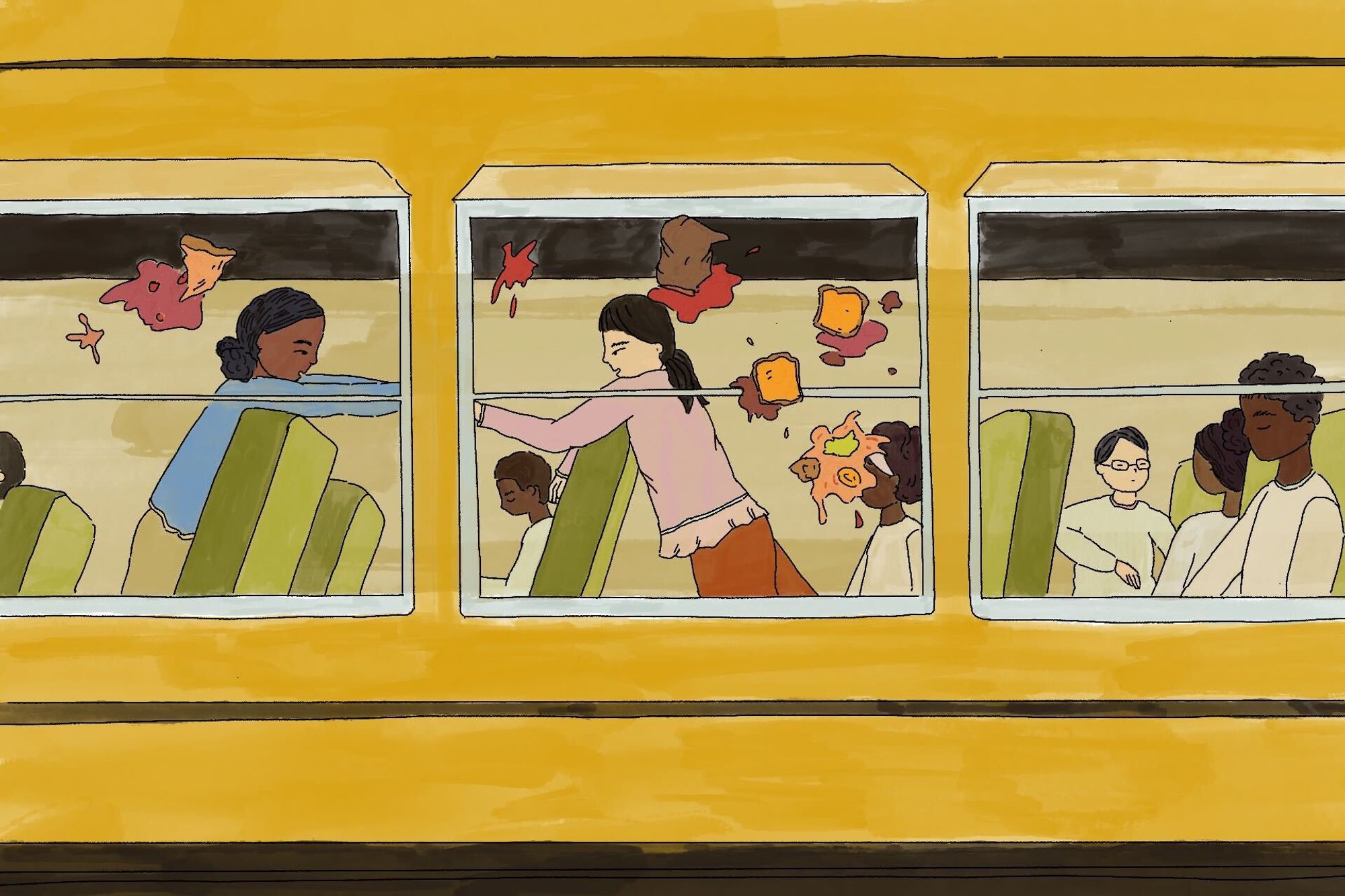
That wasn’t all the bussed children faced: Knox recalled one bus stop frequented by Blanchett High School students, who would see their bus driving by and throw their lunches at the windows.
How did the kids on the bus react? Naturally, they threw their lunches back.
“We engaged in food fights and we’d talk shit to one another,” Knox laughed. I asked Knox what it meant to be children who faced adversity alone. She shared how immigrant parents at times didn’t have the know-how to support their children through their experiences of being othered. It felt familiar to me, as a Korean American daughter of immigrants.
While Knox and Thomas both strongly relied on their friendships to get them through the trials of busing, Thomas described how challenging it was to build community at their new schools. It wasn’t until she was older when she realized how little she knew about the Cleveland High School students she considered her friends. As an adult, she realized that she was never introduced to their family members. She also recently discovered that some of their parents were the ones protesting desegregation.
Additionally, Thomas shared that when you’re bused, you’re not trying to stay on campus after school. You just want to get back on the bus since the commute was over 30 minutes. “There was no sense of community,” Thomas continued. “[Seattle Public Schools] meant well, but it was lacking. We made the best of what we had.”
The Impact of Support and Community
Even if a sense of community on campus was lacking, were friendships forged? Thomas said, “Our friendships were solid. Even today, when we do reunions, there’s white, Black, Asians. All different types of Asians. We’re all still good friends.”
Another source of support during desegregation, according to Thomas, was Cheryl Chow, who passed away in 2013 at the age of 66. She was a former state assistant superintendent of public instruction, and prior to that, vice principal and principal in Seattle Public Schools.
“Once seventh, eighth grade came around, I had a principal that wasn’t going to tolerate [prejudice],” Thomas said, describing Chow. “Miss Chow was pretty direct. And she told you how it is. And it doesn’t matter whether you’re Black, Brown, white, or purple. She’s going to tell you what you did wrong. She guided us, being in that school. And she [was the] principal of a school … that used to be an all-white school. You won’t forget Miss Chow. You can’t forget her. She was tough. She was more tough on people of color than she would be with anybody …We were lucky because she shielded us from [prejudice]. She made sure we were the best; that we showed the best of who we were from the inside, not the color of our skin. That was Miss Chow. Thinking back, that’s why she pushed me so hard. I took it for granted.”
Neither Filipinas are bitter about being bused as students of color in Seattle, nor do they look back with regret. During our conversations, stories were shared with laughter, and they consider themselves lucky despite having endured desegregation.
Still, there is a fine line between saying it was a positive experience and saying they are fortunate to gain the lessons learned. But Knox and Thomas both make it evident that they don’t see themselves as victims — they’re grateful for the friendships and how the experience shaped them. When you are growing up in a neighborhood where diversity is the default, you simply pity other children who didn’t get to experience those bonds, they told me.
The other conclusion is that despite public education’s failure to be truly inclusive of Asian Americans and other BIPOC students, essential stories like these will remain alive through the Pacific Islanders’ cultural value of talking story.
Cover: Illustration by Callie Ware